Multi-omics Network Analytics · Technical University of Denmark
We build AI that learns from biological networks. By combining multi-omics data, knowledge graphs and graph representation learning, we turn heterogeneous measurements into predictive and interpretable models of microbial communities, host–microbe interactions and human disease.
Proteomics, metabolomics and meta-omics brought together into one view of the biological system.
Graphs and knowledge graphs as a shared language for data, prior knowledge and models.
Graph machine learning, representation learning and generative models that are both predictive and explainable.
Biology is relational: function emerges from interactions between molecules, cells, organisms and their environment. Yet most computational models still treat measurements as independent features. We believe the next generation of biomedical AI will learn directly from this relational structure, representing proteins, microbes, patients and prior knowledge in a shared space where every prediction can be traced back to a mechanism.
Our goal is AI that is multimodal by construction, interpretable by design and grounded in FAIR, machine-actionable data, so that discoveries can move from the computer to the clinic and the biofoundry.
We train graph neural networks on individual-specific microbial association networks and interpret what drives their predictions. In inflammatory bowel disease, this revealed a densely connected module of co-abundant Bacteroidales whose associations, rather than abundance shifts, carry the predictive signal.
IBD graph neural networks · Graph data science in fungal biotechnology · Graph Machine Learning
From the Clinical Knowledge Graph, with close to 20 million nodes and 220 million relationships linking clinical proteomics to biomedical knowledge, to the PREFER ontology for precision fermentation, we build the structured knowledge that AI needs to reason over biology.
PREFER ontology · Graph data science in fungal biotechnology · Clinical Knowledge Graph · PREFER Ontology
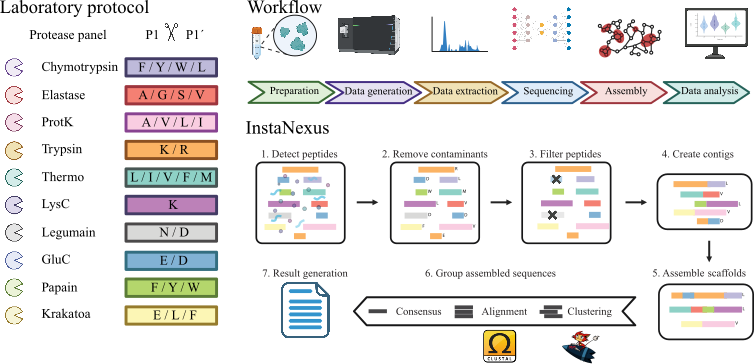
ABaCo combines a variational autoencoder with an adversarial discriminator to integrate metagenomic studies, correcting technical heterogeneity while preserving biological signal. InstaNexus couples AI-driven de novo peptide sequencing with assembly to reconstruct full-length antibodies and nanobodies directly from mass spectrometry data.
We study how microbes adapt and interact with their hosts: comparative genomics of 66 clinically relevant skin fungi, host–parasite protein interaction predictions across 46 parasites and four hosts, and statistical frameworks to find candidate genetic interactions in adaptive laboratory evolution.
ALE genetic interactions · IBD graph neural networks · Skin fungi genomics · ABaCo · ALEdb mutation QC and gene co-occurrence analysis · MGni.py · OrthoHPI 2.0 · Networks to Study Microbes
Models are only as good as their data. We argue for data-centric AI, built on curated repositories, consistent metadata and semantic standards, as the foundation for autonomous virtual laboratories, and we build the tooling that makes it practical.
PREFER ontology · Beyond the model · VueGen · MGni.py · PREFER Ontology
Our software, data and course materials are open. We teach multi-omics data analysis, protein language models, graph machine learning and network approaches to microbiology, so that these methods reach the people who generate the data.
Multi-omics Data Analysis · Graph Machine Learning · Protein Language Models · Networks to Study Microbes · GitHub
We are a multidisciplinary, international team of computer scientists, bioinformaticians and life scientists. If you are interested in a PhD, postdoc, student project or collaboration in AI for multi-omics, get in touch.
 MoNA 1.png)